
A wrap is only as good as the shop that designs, prints, and installs it. Pick the wrong one, and you could see peeling edges, faded colors, or paint damage within 2 years.
To choose the right vehicle wrap shop in Sacramento, look at 5 things. Check installer training, the vinyl and laminate they use, and their commercial portfolio. Then compare how they handle design and how clearly they explain cost, timeline, and care. A good shop answers all of these without hesitation.
Why Does the Wrap Shop Matter as Much as the Wrap?

Two trucks can carry the same design and age very differently. The difference usually comes down to prep work, material choice, and installation skill.
Poor surface prep traps dirt under the film. Rushed installs leave stretched vinyl around curves and seams. Cheap film fades fast under Sacramento summer sun. These problems show up months later, after the invoice is paid.
For contractors and service businesses, a failing wrap does more than look bad. It sends the wrong message to every customer who sees your truck at a job site.
What Training Should Your Wrap Installer Have?
Ask who will put the wrap on your vehicle and what training they have. Vinyl manufacturers run their own programs to train and test installers.
3M, for example, offers a Preferred Installer credential for individuals and a Certified Graphics Installation Company status for businesses. The company-level status requires tested installers on payroll, liability insurance, and hands-on testing at 3M’s Minnesota facility.
Not every good shop holds the top-level credential. Still, manufacturer training shows the crew knows how the film behaves on curves, rivets, and recessed panels. Learn more about why 3M installation training matters. Ask these questions:
- Who on your team will install my vehicle?
- What manufacturer training do your installers have?
- Do you use in-house installers or subcontractors?
- How many commercial vehicles have you wrapped?
Which Vinyl and Laminate Should a Wrap Shop Use?
Material quality drives how long a wrap lasts. A shop should name the film brand and explain why it fits your vehicle.
Look for cast vinyl paired with a matching laminate for full and partial wraps. The laminate adds UV and scratch protection. Cheaper calendered films can work for flat, short-term graphics, but they shrink and lift faster on curves.
Ask about finish options too. Many shops offer gloss, matte, metallic, or carbon fiber looks. A good shop will explain how each finish holds up on a work vehicle over time.
What Should a Wrap Shop’s Portfolio Include?
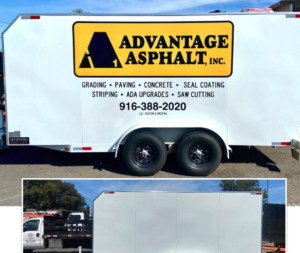
A portfolio full of color-change sports cars tells you little about fleet branding. Work trucks, vans, and trailers need different design thinking.
Commercial graphics must read clearly at a distance and at speed. Your company name, service, and phone number should be legible from across a parking lot. Ask to see examples like these:
- Work trucks and service vans
- Sprinter vans and box trucks
- Trailers and equipment
- Multi-vehicle fleets with consistent branding
If possible, ask to see a wrap that has been on the road for a few years. That shows you how their work holds up over time.
Should the Shop Handle Design In-House?
Ideally, yes, because one team then owns the result from design to install. Some shops only install. Others print but send design work out. A shop that handles design, printing, and installation under one roof keeps your project consistent from start to finish.
In-house designers can measure your actual vehicle and plan around door handles, body lines, and windows. That avoids awkward cuts through a logo or phone number. It also makes revisions faster, since you deal with one team instead of 3 vendors.
Ask how many design proofs are included. Also ask whether you will see a digital mockup on your exact vehicle model before printing starts.
What Should a Vehicle Wrap Quote Include?
A solid quote breaks out design, materials, coverage level, and installation. Vague, single-line pricing makes it hard to compare shops fairly.
Coverage options affect cost the most. Many shops offer partial graphics in set increments, such as 1/4, 1/2, or 3/4 coverage. Full wraps and simple decals round out the options. If you’re unsure which level fits your budget, this breakdown of full wraps, partial wraps, and decals can help.
Ask about the timeline in writing. A full commercial wrap often takes several business days once you include design approval, printing, and install. For fleets, ask whether the shop can stagger vehicles so your crews stay on the road.
Can a Vehicle Wrap Damage Your Paint?
A quality wrap protects factory paint. It can make existing problems worse, though. Wrap adhesive can pull up failing clearcoat or paint that hasn’t fully cured.
A trustworthy shop inspects your vehicle before quoting and tells you about any risk spots. It should also explain how removal works when the wrap reaches the end of its life. Professional removal keeps the paint underneath intact.
What Warranty Should a Wrap Shop Offer?
Ask what the shop covers and for how long. Film manufacturers often warranty the material, while the shop covers its own installation work. Get both in writing so you know who to call if an edge lifts.
Good shops also send you home with care instructions. Hand washing, mild soap, and keeping pressure washers away from edges all extend wrap life. Here’s a full guide on how to care for your vehicle wrap so it lasts longer.
What Red Flags Should You Watch For?
Walk away or ask more questions if a shop:
- Won’t name the vinyl brand it uses
- Quotes a price without seeing or measuring your vehicle
- Shows only personal or show-car work
- Can’t explain who installs and how they were trained
- Offers no written warranty or care instructions
- Promises a full wrap in a few hours
Frequently Asked Questions
How long does a commercial vehicle wrap last? Most professional wraps last about 5 to 7 years with routine care. Film brand, climate, and how the vehicle is stored all play a role. Horizontal surfaces like the hood and roof usually wear first. See how long vehicle wraps last in Sacramento’s heat.
Is a 3M-trained installer the same as a 3M Certified company? No. Training means installers learned 3M’s methods. Certified Graphics Installation Company status is a separate business-level credential with testing, insurance, and site visit requirements.
Should I choose the cheapest quote? Not by default. A lower price often means thinner film, no laminate, or less prep work. Compare materials and coverage line by line before deciding.
Can one shop handle my whole fleet? Yes, if it has the capacity and in-house design. Ask how the shop keeps branding consistent across different vehicle makes and sizes.
Do I need to bring my vehicle in for a quote? Not always for a rough estimate. For an accurate quote, a shop should see the vehicle, confirm measurements, and check paint condition.
Talk to a Sacramento Shop That Wraps Work Vehicles
Capitol Barricade has served Northern California businesses for more than 50 years. Our Pro Vehicle Graphics team handles consultation, design, printing, and installation in-house. Our 3M-trained fleet graphic installers wrap work trucks, sprinters, trailers, and equipment.
Have a truck or fleet that needs branding? Give us a call at 916-451-5176 and we’ll walk you through coverage options for your vehicles.