- 6001 Elvas Ave, Sacramento
- (916) 451-5176



If you are managing a construction project in Sacramento, you have a lot to handle. Permits, timelines, crews, and budgets all compete for your attention. Traffic control is one area where you cannot afford to cut corners. Many contractors and project managers in Sacramento are unsure whether their project requires a formal traffic control plan. The short answer is: if your work touches the public right of way, you almost certainly do.
We have spent over 50 years in the traffic control industry here in Northern California. We have helped contractors, utility companies, and event organizers navigate these requirements. This guide covers what you need to know before your project breaks ground.
A traffic control plan (TCP) is a formal document that outlines how traffic will be managed around your work zone. It maps out the placement of traffic control devices, cones, barriers, barricades, signs, and detours. It communicates to drivers, workers, and inspectors exactly how the job site will be staged at each phase.
A TCP is not a one-size-fits-all form. Every plan is tailored to the specific location, size, and complexity of the project. A simple lane closure on a side street requires a different approach than a multi-lane closure on a busy arterial. The plan has to account for pedestrians, bicyclists, and drivers at the same time.
California requires all TCPs to comply with the California Manual on Uniform Traffic Control Devices (CA MUTCD). Projects on state highways must also meet Caltrans standards. Work on city streets and county roads must meet local regulations set by the governing agency.
Sacramento County’s Department of Transportation requires a TCP for all construction work within the road right of way that modifies vehicular, bicycle, or pedestrian traffic patterns. This applies to a wide range of projects. Here are common situations that trigger the requirement:
Any time you close or restrict a lane on a public street, a TCP is required. This includes partial closures, full closures, and temporary lane shifts.
Water, gas, electrical, and telecom crews working in or near streets need a plan in place. Digging in the public right of way means managing traffic around the obstruction safely.
When construction blocks pedestrian access, an ADA-compliant detour must be in place. A TCP documents that detour and ensures it is handled correctly.
Sacramento hosts festivals, races, and community events throughout the year. Events that use city streets or public areas require a TCP to ensure the safe and efficient movement of both attendees and drivers.
If your project requires an encroachment permit from the city or state, a TCP is part of that application. You cannot get the permit without the plan.
Note that requirements can vary by jurisdiction. Work in the City of Sacramento, Sacramento County, and adjacent cities may each have different submission processes. When in doubt, check with the permitting office early. Getting the plan wrong adds time to your project.
Skipping or delaying your TCP creates real problems. A missing or non-compliant plan can result in:
Workers and drivers are both at risk when work zones are not properly managed. A compliant, well-designed TCP is not just a bureaucratic requirement. It is a safety document that protects people on your job site and the public using the streets around it.
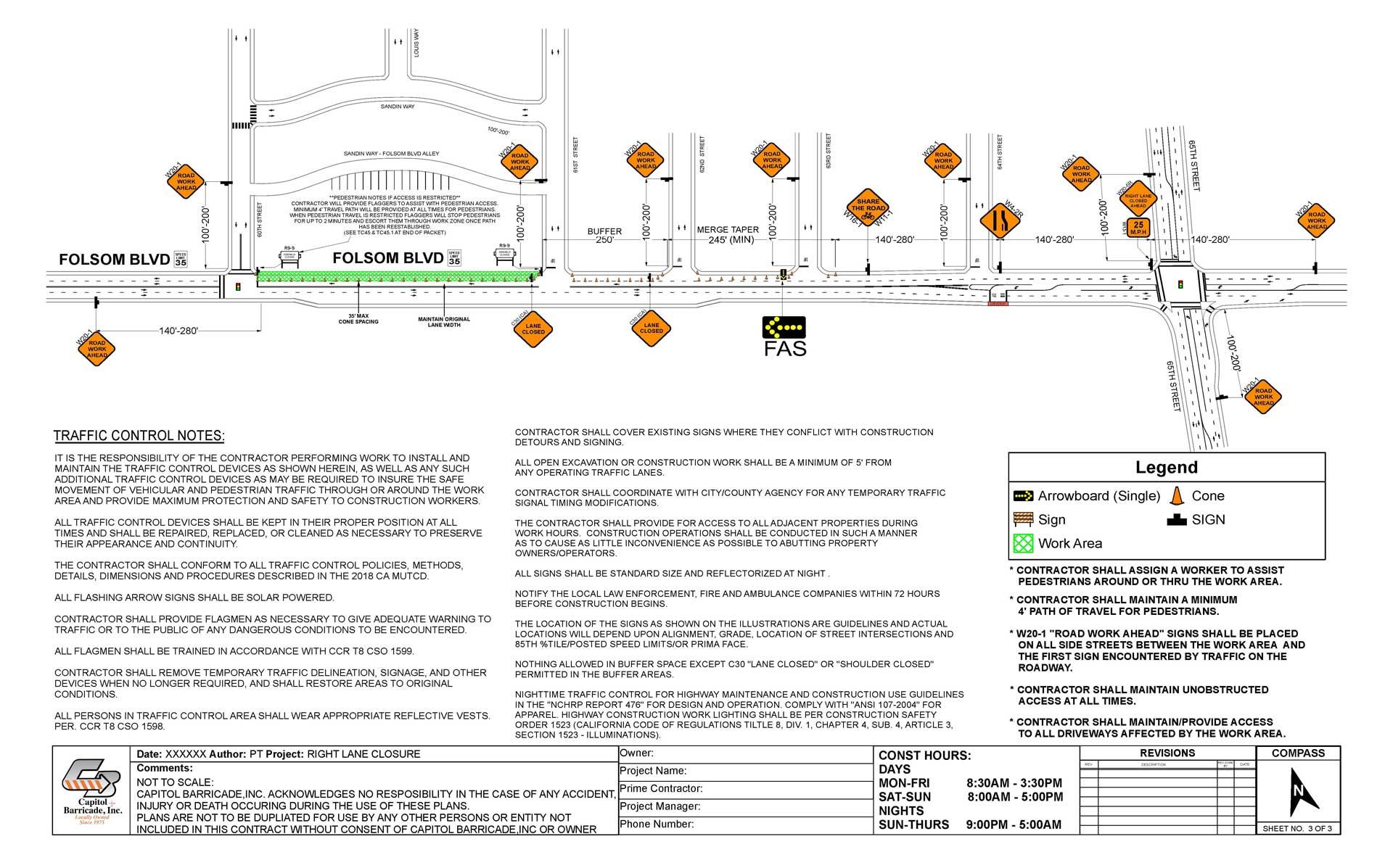
A professionally drawn TCP covers every element needed to manage traffic safely through or around your construction area. A complete plan typically includes:
Work zone layout. The plan shows exactly where cones, barricades, barriers, and signs will be placed. Device spacing, taper lengths, and buffer zones are all specified to meet state and local requirements.
Signage and notification. Advance warning signs alert drivers well before they reach the work zone. The plan documents sign locations, sizes, and message requirements. Notification to the public and nearby businesses is often required as well.
Detour routes. When streets must be closed, detours direct traffic to alternate routes. The plan documents those routes clearly so drivers can navigate without confusion.
Flagging and personnel. Site-specific flagging plans identify where flaggers will be positioned. Flagger stations must be placed to allow for safe, efficient movement of traffic through the area.
Phasing. Larger projects often require multiple stages. The TCP documents each phase so the work zone transitions are covered and compliant throughout the project.
Our traffic control plan team uses cutting-edge industry software to design and manage plans. We produce them in clear, accessible layouts that communicate well to crews, inspectors, and agency reviewers.
Not every project requires the same level of plan. There are two main categories:
Non-engineered TCPs follow standard templates from the CA MUTCD. These work for common, lower-complexity situations such as basic lane closures or simple utility work on local streets. They do not require a stamp from a licensed engineer.
Engineered TCPs are required for more complex projects, unusual site conditions, or work on state highways. These plans must be reviewed and stamped by a California-certified engineer. Many Caltrans encroachment permit applications fall into this category.
We handle both. Our team can advise you on which type your project requires and navigate the submission and approval process with you at state and county engineering offices.
We have been providing traffic control services in Sacramento and Northern California for over 50 years. Our TCP department is staffed by experienced professionals who know local regulations, Caltrans requirements, and the specific expectations of Sacramento-area permitting offices.
Here is what we provide:
We also offer flagging services, rentals, and sales of traffic control devices, cones, barricades, signs, and more. You can handle your TCP and source your equipment from one location. That makes coordination easier and keeps your project moving.
Our plans are fully compliant with the CA MUTCD and designed with work zone, pedestrian, and vehicle occupant safety in mind. We tailor every plan to your specific project conditions, location, and requirements. Reliability and performance are not optional on a job site. We take that seriously.
The best time to start your TCP is before you submit your permit application. Waiting until the last minute is one of the most common reasons projects get delayed. Agencies have review timelines, and incomplete or non-compliant plans restart that clock.
Here is how the process works with us:
For additional information about Sacramento County’s TCP requirements, visit the Sacramento County Department of Transportation.
Whether you are managing a road construction project, planning a special event, or handling a utility repair on Sacramento city streets, we are here to help. Our team brings 50 years of experience and deep knowledge of Northern California’s traffic control requirements to every project.
Do not let a missing or non-compliant TCP hold up your work. Contact us today to get started or request a quote for your traffic control plan.
Capitol Barricade 6001 Elvas Ave, Sacramento, CA 95819